WHAT WE’RE BUILDING
Development begins either with an identified production need or with a technological opportunity worth translating into useful industrial capacity. This is not a catalogue. It is a view into how McMellion turns problems, evidence and engineering discipline into machines and production systems.

CURRENT DEVELOPMENT / PK-DMS
01 / ORIGIN
An identified need
Development begins where production stalls—through lost time, wasted energy, unsafe work, inconsistent output or equipment that does not fit the operating reality.
02 / ORIGIN
A technological opportunity
A technological opportunity exists where sensing, automation, controls or a different mechanical principle can make production simpler, more dependable and more productive.
In both cases, observation comes first. Proprietary detail remains protected, and development proceeds only where the evidence justifies it.
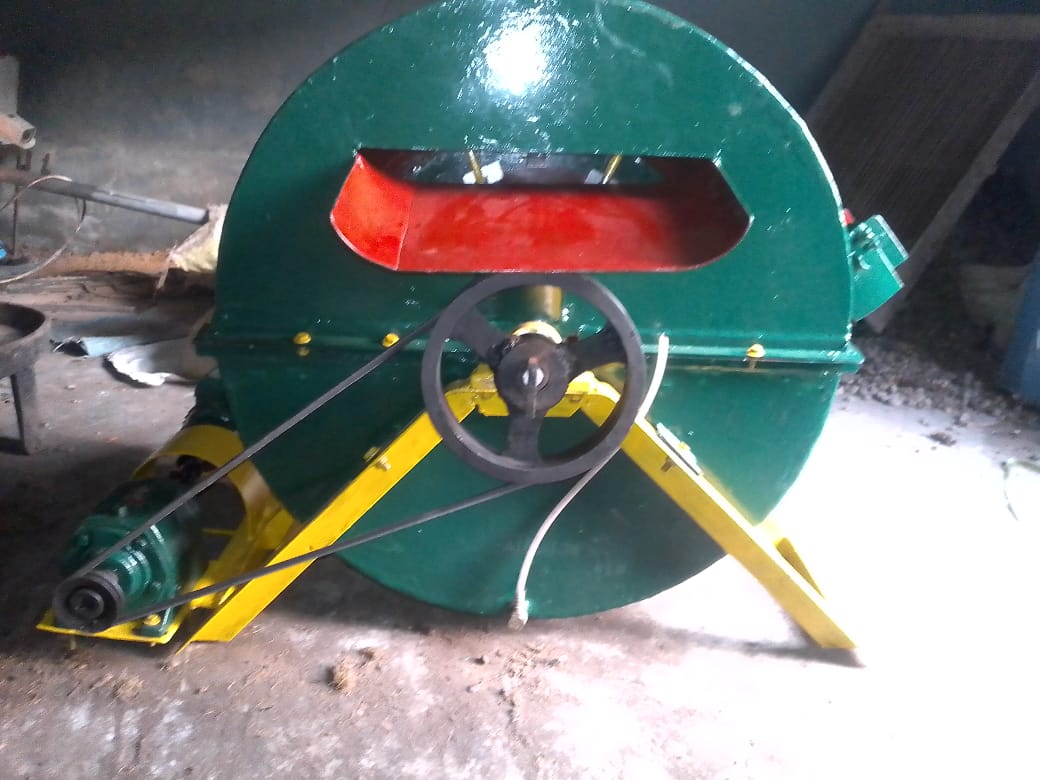
PK-DMS / PROTOTYPE UNIT
01 / CURRENT DEVELOPMENT
Palm Kernel Dense Media Separator
PROBLEM
Palm-kernel separation remains one of the processes that stalls the full mechanisation of palm-kernel oil production. Existing methods often sit awkwardly between efficiency, energy demand, operating simplicity and equipment cost.
QUESTION
Can the separation be made more effective without turning a small or medium processor into the operator of an oversized, energy-intensive system?
WHAT WE’RE BUILDING
A compact dense-media separation system designed around the behaviour of palm kernel and shell in a controlled medium—not a copy of cyclone technology. The current development unit is McMellion’s first proving ground for turning field evidence into maintainable production equipment.
STATUS
Prototype built and tested. Patent filed. Development continues toward commercial readiness.
0.5 t/h
TESTED THROUGHPUT
0.75 kW
DRIVE POWER
92%
SEPARATION EFFICIENCY
02 / IN DEVELOPMENT
SPPS
Smart Palm Processing System
PROBLEM
Small and medium palm-oil processors often depend on disconnected machines, repeated handling, multiple processing stages and the judgment of individual operators. Time, energy and product are lost between processes.
QUESTION
What changes when digestion, separation and pressing are designed as one coherent production system rather than as isolated machines?
WHAT WE’RE BUILDING
An integrated, semi-continuous processing system combining mechanical design, sensing, control and practical material flow. The intention is to shorten processing time by at least 50%, reduce handling and produce more dependable output without pricing the system beyond its users.
STATUS
Engineering development. Subsystems are under analysis and design. Market intelligence and field evidence continue to inform the architecture.
01 / INPUT
02 / DIGEST
03 / SEPARATE
04 / PRESS
03 / EARLIER PROOF OF CONCEPT
PCAH
Palm Climbing and Harvesting System
PROBLEM — Harvesting from tall palms remains physically demanding, dangerous and dependent on scarce skilled climbers.
QUESTION — Can access, stability and cutting support be engineered into a practical machine that reduces risk without ignoring field conditions?
WHAT WE BUILT — A human-scale climbing and harvesting concept developed around controlled movement, operator safety and the realities of palm plantations. It treats labour-intensive work as a systems problem—not simply a task to be handed from person to machine.
STATUS — Earlier proof-of-concept and engineering study. Not yet in active commercial development.
FIELD ACCESS / OPERATOR SAFETY / CUTTING SUPPORT
Human-scale systems study
BEYOND THE CURRENT PIPELINE
Agro-processing is where McMellion is currently proving its engineering discipline. The capability under development—problem definition, modelling, mechanical design, automation, prototyping, testing and manufacture—is intended for the wider production challenges that constrain African industry.